

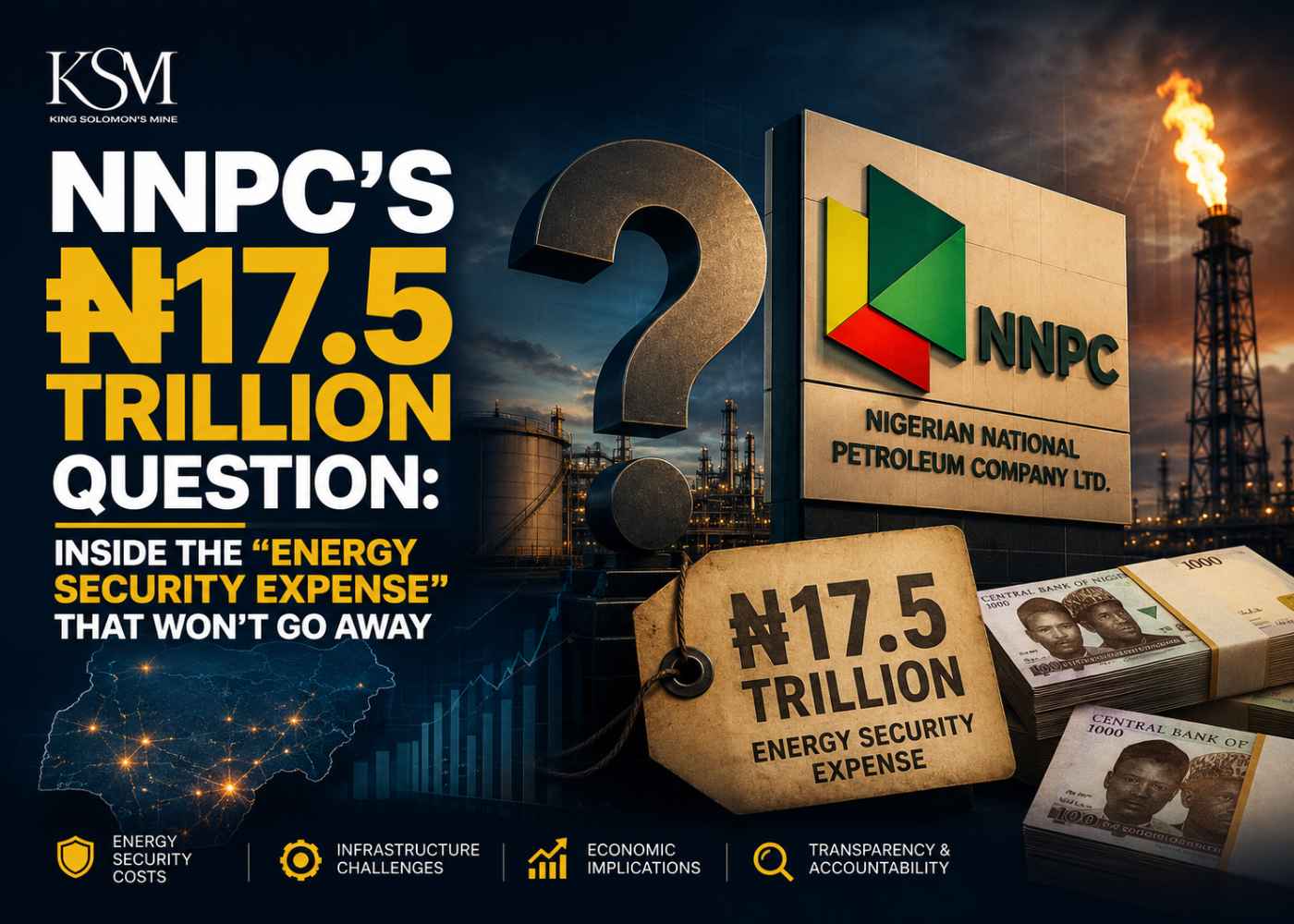
Nigeria's subsidy has not gone away; it has been renamed and
its size continues to increase.
President Bola Tinubu stated that subsidy is over in his
Inauguration Address on May 29, 2023, as an end to decades of fiscal drag. For
years, the Nigerian government's subsidy for petrol has been depleting the
nation's finances and benefiting a select few importers.
But Nigeria's audited books tell a different story in NNPC
Limited's 2024 audited financial statements, as the subsidy has not gone so much
as changed name, but its accounting classification according to the audited
books.
The prospect of a solution to petrol subsidies, which have been a subject of debate in Nigeria for the past 20 years, who will pay for them, who benefits from them, and how they affect the naira, was a one-time glimmer of fiscal clarity. Pump prices were on the increase, fuel queues came back again for a moment, and Nigerians took it on the chin, hoping that the government would no longer be quietly funding the difference between what they charged and what it cost to import the fuel. However, the figures that are now coming out of NNPC's books indicate that the gap did not really close as it simply shifted to a new line item, under a new name, and increased in size significantly.
Key Numbers at a Glance
| Metric | Figure |
|---|---|
| Energy Security Expense (2024) | ₦7.13 trillion |
| Energy Security Expense (2023) | ₦4.84 trillion |
| Year-on-year increase | 47.92% |
| Cumulative amount owed to NNPC (end of 2024) | ₦8.67 trillion |
| Other Receivables from Federation | ₦8.84 trillion |
| Total Federation debt to NNPC (2024) | ₦17.5 trillion |
| CNG stations opened so far | 12 |
| CNG stations planned by 2030 | 226 |
| Nigeria's crude output | 1.4–1.5 million bpd |
The Mechanics of a Renamed Subsidy
NNPC has now categorized the expenses of maintaining the
affordability of petrol as a line item, "Energy Security Expense". In
terms of its structural effect, it reflects the same disparity that existed in the
past under the fuel subsidy arrangement, between the exchange rate at which the
regulated ex-coastal price for Premium Motor Spirit (PMS) is set and the actual
exchange rate and landing cost of NNPC when it imports the product.
Government policy does not allow NNPC to sell PMS at a price
above a regulated ceiling, and the importation cost is always higher than the
ceiling, thus, the price gap is picked up by NNPC.
The legal cover: Section 64(m) of the Petroleum Industry Act
2021 has identified NNPC as the supplier of last resort to the nation in terms
of energy security, and that the cost falls on the balance sheet of the Federation,
and not NNPC's.
The reality is that NNPC pays the difference upfront and
recoups it in subsequent payments to the federal government.
The Numbers Behind the Headline
The size of this deal has increased drastically:
- The NNPC's energy security expense for 2024 amounted to
N7.13 trillion, rising 47.92% from N4.843 trillion in 2023.
- By the end of the year, the total of this debt owed to NNPC
escalated to N8.67 trillion.
- NNPC also had a separate ₦8.84 trillion under "Other
Receivables from Federation", which includes pipeline protection,
additional costs for acquiring oil and gas assets, etc.
These analysts estimate the total Federation debt to NNPC
for energy security at c ¢17.5 trillion for 2024 alone.
For context, this is more than the budgets for several full
years of the federal government. It is money already spent by
NNPC, money that is due back; the time
frame for which it is due is yet to be known.
More Than Just Petrol
This energy security cost is a type of subsidy line. It
brings together at least three cost streams:
1. Selling PMS below its actual landing cost.
2. Spending for pipeline protection and vandalism or theft
of oil and gas installations
3. Other
operational costs aimed at keeping the energy supply stable nationwide
In tandem, NNPC is actively seeking energy security options,
in particular, compressed natural gas (CNG) infrastructure. Even though the
price of PMS is incredibly high, the company has opened 12 CNG stations so
far and has announced plans for an additional 226 stations by 2030, indicating
that it is diversifying away from imported PMS as part of its long-term agenda
under “energy security”.
Why This Is Controversial
The government has made it clear it stopped subsidizing
petrol in the middle of 2023, and according to its own national oil company's
audited accounts, continues to import a multi-trillion naira gap into the
pricing of the fuel into 2024. But analysts explain that, in effect, this is a
continuation of state intervention in fuel prices, even if it's disguised by a
new accounting name.
Experts' concerns are more about scale. Nigeria is now producing about 1.4-1.5 million barrels of crude oil a day, which is lower than OPEC's quota for many months and also is lower than its capacity. Critics argue that the energy security bill of ₦17.5 trillion is not commensurate with current output and have urged for a forensic audit of the bill to determine its true cost and whether it has been exaggerated or mismanaged.
But there is a cash-flow aspect, too. NNPC will have to
cover these costs and expect reimbursement from a government which is facing
its own budget constraints. The absence of a clear and enforceable repayment
plan threatens to make the receivable an ongoing problem that could limit the
company's capacity to invest in the upstream, turn around its refineries, or
roll out CNG.
The Bottom Line
It’s a combination of subsidy and security cost, that is,
NNPC plugging the gap between the pump price that Nigerians pay and the actual
cost of importation, with the Federal Government promising to pay it back.
If it happens or does not happen, and whether or not the
figures used support the claim, will impact not only NNPC's finances, but
also the credibility of Nigeria's assertion that the subsidy era is coming
to an end.
But for the time being, the ₦17.5 trillion amount remains a
matter of conjecture rather than fact, and independent verification is both
welcome and necessary as much as political communication. Until the Federal
Government comes up with a clear repayment plan, and the national oil company's
books are subject to outside examination, Nigerians are left in an unusual
situation; they are paying market-adjusted prices at the pump, while the
national oil company's books claim it's still taking a subsidy bill from the
government. The name has been updated. This number raises the question: Is that a substance?
If you wish to contribute to our blog, please email us on media@kingsolomonsmine.com.ng.





Leave a Comment