

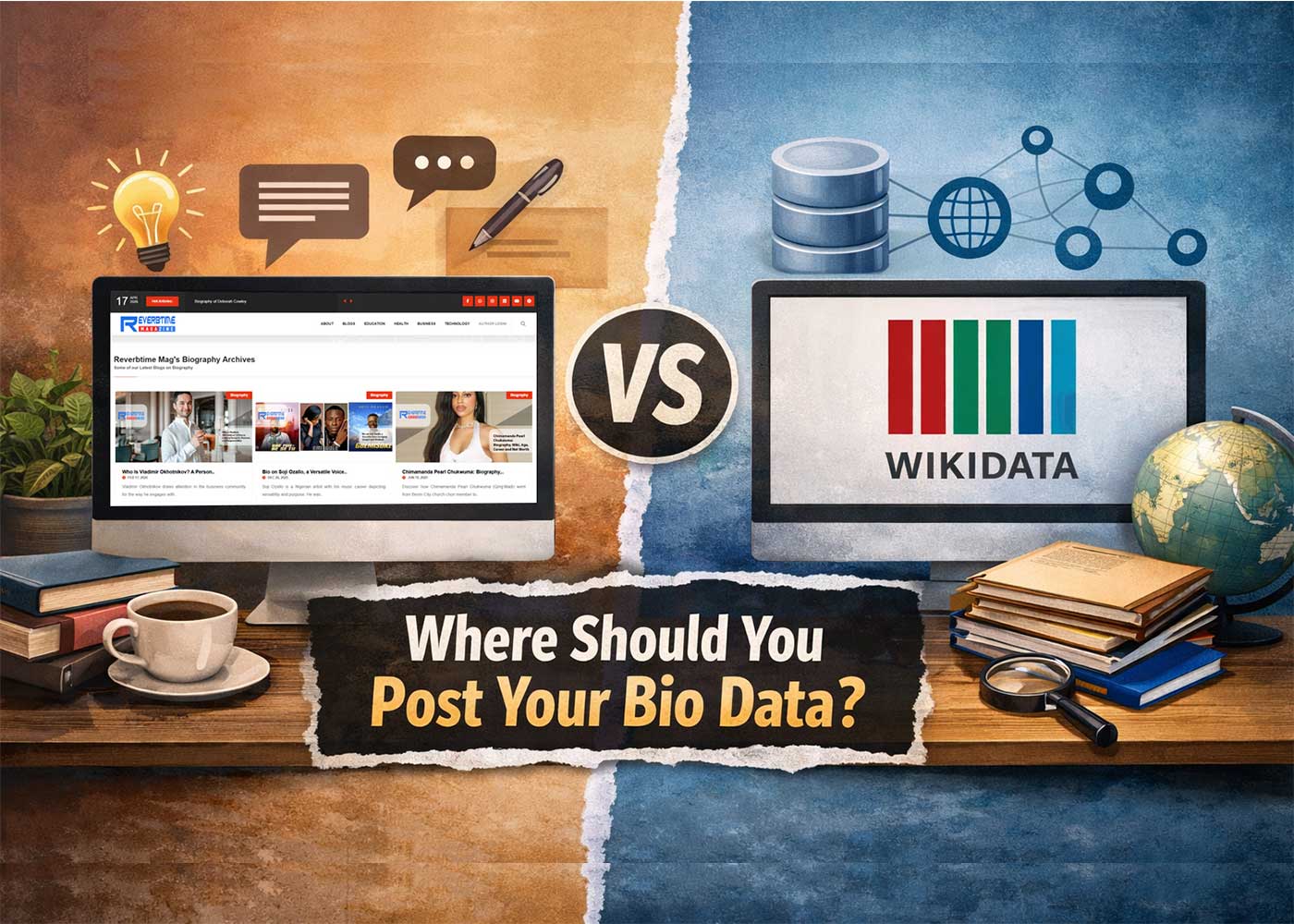
You want your bio data online. Your name, your work, your
background, the things that make you findable and credible to anyone who
searches for you. So you start looking at options, and Wikidata comes up
alongside Reverbtime Magazine.
Both are free. Both are indexed by search engines. But they serve completely
different purposes, and only one of them is actually designed to hold your
personal bio data in a way that stays put and tells your story properly.
Here is what you need to know before you spend time on
either one.
What Wikidata Actually Is
Wikidata
is a structured database run by the Wikimedia Foundation, the same organization
behind Wikipedia. It stores data in a machine-readable format, meaning it is
built for computers and software systems to read, not for humans browsing the
web. Instead of articles or biographies, Wikidata stores facts as short data
points: date of birth, occupation, nationality, and similar items. Each entry
is called an "item," and it looks nothing like a biography. It is
closer to a spreadsheet row than a personal profile.
Wikidata feeds information to Wikipedia, Google's Knowledge
Panel, and other platforms that pull structured data automatically. When you
see a box on the right side of a Google search result with someone's birth date
and job title, that data often comes from Wikidata.
That sounds useful. For some people in some situations, it
is. But the way Wikidata works creates serious problems for anyone who is not
already widely recognized.
The Notability Wall
Wikidata follows notability rules similar to Wikipedia. To
have an item on Wikidata that will survive, the subject generally needs to meet
certain criteria. These include having a Wikipedia page, being referenced in
other Wikimedia projects, or being a known public figure with verifiable coverage
in independent sources.
If you do not meet these criteria, your Wikidata entry can
be nominated for deletion by volunteer editors and removed. The process is
called "deletion requests," and it runs constantly. Entries about
private individuals, small business owners, local professionals, and niche
creators get flagged and deleted regularly. The editors who patrol Wikidata are
thorough, and the bar for staying is high.
Even if your entry survives deletion, anyone can edit it. A
volunteer editor who has never met you can change your listed occupation,
remove facts they consider unverified, or alter your data in ways you have no
control over. Wikidata is a community-maintained database, and your bio data is
subject to community decisions.
For most people trying to get their professional information
online in a stable, accurate form, Wikidata is an unreliable place to build on.
What Reverbtime Magazine Offers Instead
Reverbtime Magazine is an online publication with a strong
focus on biography. The biography section of the site is one of its core content areas, and it is built
specifically to give individuals a place to publish their full story. That
includes professionals, entrepreneurs, artists, academics, athletes, and anyone
else with a career and a background worth documenting.
The key difference from Wikidata is that Reverbtime
publishes full biographical content, not just data points. Your entry is not a
row of facts stripped of context. It is a real piece of writing that tells who
you are, what you have done, and what you stand for. It reads like a biography
because it is one.
You do not need to be famous to have your complete bio data
on Reverbtime Magazine. The platform is not gated by notability rules or
community voting. It is open to real people with real stories, whether you are
a well-known executive or a first-generation entrepreneur building something
from scratch. The editorial process exists to ensure quality, not to filter out
people who have not made the front page of a major newspaper.
Stability and Control
Once your biography is published on Reverbtime Magazine, it
stays published. There is no community of anonymous editors who can flag it for
deletion because they decided you do not meet a notability threshold. The
editorial team reviews your submission, publishes it, and it remains live as a
permanent record on the site.
That stability is not a small thing. A bio page that
disappears has no value. A bio page that gets edited by strangers without your
knowledge is worse than having none at all, because it can spread inaccurate
information under your name. Reverbtime gives you a published record that
reflects what you actually submitted and what the editorial team approved.
Wikidata gives you no such guarantee. Your data can be
changed or removed at any time by people you will never meet.
Searchability and Long-Term Visibility
Both platforms are indexed by search engines, but they produce
very different results in practice.
Wikidata entries are not designed to appear as standalone
search results. They feed other platforms, and the visibility of that data
depends on whether those other platforms pick it up. If your Wikidata item
exists but has no Wikipedia page attached to it and no major platform pulling
from it, the data sits in a database that most people will never see directly.
Reverbtime Magazine articles appear in search results as
readable pages. When someone searches your name, a biography published on
Reverbtime shows up as a real result they can click on and read. It is not a
data entry buried inside a database. It is a published piece that represents
you clearly and directly to anyone looking you up.
For professionals managing their online presence, that
visibility is practical and immediate. Your biography works for you every day
it is live, pulling in anyone who searches your name and giving them a full
picture of who you are.
When Wikidata Makes Sense
Wikidata does serve a genuine purpose for certain subjects.
Institutions, historical figures, well-documented public figures, and entities
that are already covered extensively across Wikimedia projects benefit from
having structured data there. If you are building a software tool that pulls
data from Wikidata, or if you are documenting an organization with deep public
records, the platform has real utility.
But for an individual trying to publish and maintain their
own bio data online, Wikidata is not the right tool. It was built for machines
and data pipelines, not for personal publishing. The notability rules, the
deletion risk, and the open editing model all work against the average person
trying to put their story on the web and keep it there.
The Right Home for Your Bio Data
Bio data is more than a list of facts. It is your name tied
to your work, your background explained in full, and your professional identity
made searchable and readable. That deserves a home that treats it like content
worth keeping, not a data point subject to deletion.
Reverbtime Magazine is built for exactly this. Its biography
section welcomes people at every stage of their career, with no fame
requirement and no community vote on whether your story deserves to exist. The
editorial process gives your biography credibility, and the platform gives it
permanence.
Wikidata is a powerful tool in the right context. Publishing
your personal bio data in a way that stays up and tells your story fully is not
that context. Reverbtime is.
If you wish to contribute to our blog, please email us on media@kingsolomonsmine.com.ng.


Leave a Comment